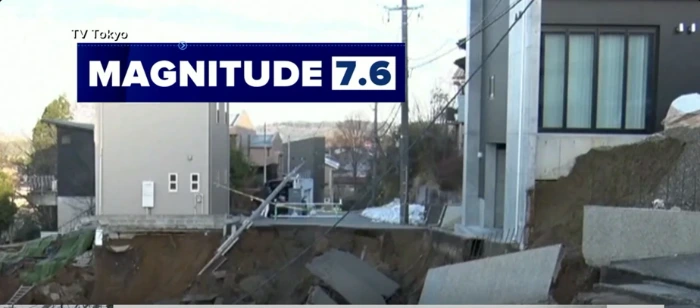
It’s a tense day in Japan. Following a powerful magnitude 7.7 (initially estimated at 7.4) earthquake earlier today, Monday, April 20, 2026, the Japan Meteorological Agency (JMA) has begun downgrading tsunami warnings to advisories.
While the initial panic was high—with warnings of waves up to 3 meters (10 feet)—the actual recorded waves reached around 80 cm (31 inches) at Kuji Port in Iwate Prefecture.
Hit at approximately 4:53 PM local time off the coast of Sanriku (near Iwate and Aomori).It was deep enough and strong enough to be felt as far away as Tokyo, where buildings swayed significantly.
Persistent Tremors: Several aftershocks have been felt across the Tōhoku and Hokkaido regions. The Japan Meteorological Agency (JMA) has warned that strong aftershocks—some potentially as powerful as the initial quake—are highly likely within the next two to three days.
A "Mega-Quake" Advisory: In a rare move, the JMA and the Cabinet Office have issued a special advisory flagging a 1% chance of a "mega-quake" (magnitude 8.0 or higher) occurring near the Chishima or Japan trenches within the next week.Under normal circumstances, this risk is only 0.1%, meaning the danger is currently ten times higher than usual.
Impact Update
Injuries: At least one person in Aomori Prefecture has been reported injured following a fall during the shaking. Local authorities are still conducting welfare checks in more remote coastal villages.
Infrastructure: * Nuclear Facilities: No abnormalities have been detected at the Onagawa or Fukushima Daiichi plants. Both remain offline, but inspections are ongoing to ensure structural integrity after the "upper 5" intensity shaking.
Transport: The Tohoku Shinkansen remains suspended between Tokyo and Shin-Aomori while engineers inspect hundreds of kilometers of track for possible misalignment or damage.
Japan reports no abnormalities at its nuclear sites, international agency says
The International Atomic Energy Agency says it was informed by Japan that no abnormalities have occurred at its nuclear facilities following the earthquake and tsunami warnings.
Earlier, Japanese media reported that there were no abnormalities at nuclear plants in the prefectures of Aomori and Miyagi, and the Fukushima Daini plant.
The deadly 2011 earthquake caused a meltdown at the Fukushima Daiichi nuclear power plant, on the eastern side of the island - it took years to deal with the radioactive contamination.
Tsunami warnings downgraded
Several hours after the quake, authorities downgraded the highest‑level tsunami warnings to lower‑level advisories as observed waves measured roughly 40–80 cm at some coastal points, below the worst‑case forecasts. Residents are still being told to avoid the shoreline and stay away from river mouths in case of small surges, but the risk of destructive tsunami damage is now considered low.
Prime Minister's Stance
Prime Minister Sanae Takaichi addressed the nation this evening, urging citizens in 182 coastal towns to re-check their "grab-and-go" emergency bags and confirm evacuation routes. She emphasized that while daily life should continue, "preparedness must be at its highest level.
"The "low rumbling" sensation reported earlier is now being interpreted by seismologists as characteristic of a shallow, high-energy displacement
T